EducationPlus

EducationPlus
St. Louis Regional Professional Development Center

Wednesday, January 19, 2022

My Three Reasons for Entering Education

 Dr. Peter M. DeWitt challenged each of us to share our #3REASONS for entering the field of education. This is such a timely challenge as we are facing unique times in education. Now is the perfect time to reflect on why we became educators. Here are my three reasons...

To help others discover their hidden potential  Assisting students in unearthing  potential talents and skills is every exciting work.  As a classroom teacher I taught theatre arts. An array of students enrolled in my high school theatre classes. Students who were part of the Theatre Ars Department, students needing a Fine Arts credit, students taking the class to fill their schedule, or those taking the classes because they heard they were "fun". No matter the reason, it was important for me to embrace their reason and purpose. That is how I started the first class of each semester, understanding their "WHY" for each particular theatre course. From here I would learn about their skills, interests, hobbies, and talents. Now, my Tech Theatre class was charged with building the sets for our four theatre productions each each year. This class entertained the most diverse group of student interests (Their skills, interests, and hobbies). Their interests helped determine how they would each be challenged to discover their hidden potential. One semester, three students stayed after school to continue building the set for the musical "Once Upon a Mattress".  We were in mid rehearsal when the students rushed into the Drama Center to let me know they had an idea for Princess Winnefred's bed and they wanted to get to work on it right away. If you know this show, the musical is based on the literary fairy tale "The Princess and the Pea". The bed, comprised of 23 mattresses, was one of the most challenging set pieces. Observing these students take time after school to work through an epiphany they had regarding the set still gives me goose bumps today. We all have stories like this one were we help students discover their hidden potential. Note: These three students enrolled in this class (multiple times) serving as set construction team leaders. 

To empower learners to achieve success  In "The ArtisanTeacher: A Field Guide to Skillful Teaching", Dr. Mike Rutherford shares twenty-three key educational themes that will impact student learning. Regarding the theme of Success (the ability of the teacher to increase and sustain student effort by designing and adapting learning tasks to ensure that students experience success) students will withhold efforts on educational experiences in which they perceive as too difficult, something they cannot do or achieve. In understanding this important facet of student success, it is my responsibility to make sure each student achieves success by breaking down the learning into simpler tasks, activities, projects. Once the student experiences success on a smaller scale, their confidence begins to grow and they are more willing to take risks on more difficult experiences.  This is the way to spark student effort in the classroom. Once this takes place, watch out as the students will take the ball and run with it. 

To share my passion for learning with others  I love education. No  reservations, restrictions, or excuses, I loved going to school, loved learning, and just thoroughly enjoyed the complete experience growing up. I guess that is why I was named "Mr. School Spirit" my senior year of high school.  Having a shared passion, I know each of us brings a different perspective to the classroom experience and so we may not all share this intense interest in education. Some students may not like school at all, some may only come to school for the social facet, or after school activities. Understanding and respecting this perspective helped me fashion my lessons and learning experiences to help spark a love of learning in my students. For many teachers former students return to visit sharing that they've continued on in a specific field of interests based on that teacher's passion. Nothing is more rewarding than this. Several of my students continued on studying theatre in college. Some making a career in technical or performance theatre. Reading about their successes, watching them perform, and cheering them on as they pursue their "dreams" is magical. 

So, what are your #3REASONS for becoming an educator? I want to read about your three reasons. Post your reasons in the comments below, on Twitter, or in a blog post. I look forward to learning your how you impact your students. 

Saturday, January 8, 2022

My "One Word" for 2022: Community

Each December I begin the process of selecting my One Word for the upcoming year. This December was no different from any other year. The only exception is I am reviving my blog and will use my One Word as the for posts during 2022. After reflecting on 2021 and considering several words, a few came to mind that could possibly serve this purpose. However, when Community came to mind, I knew immediately it would readily frame my focus for 2022. 

Jon Gordon, author of “One Word that will change your life”, explains that by narrowing your focus to a “one word” vision you add clarity and focus to your year.  Gordon’s January 1, 2014 appearance on the Today Show solidified my decision to begin this process.  I have been using his One Word focus since 2014. You can learn more about selecting your “One Word” by checking out Mr. Gordon’s website: http://getoneword.com/

Community is defined as "a unified body of individuals: such as a body of persons of common and especially professional interests scattered through a larger society." There are four types of communities: Interest (Communities of people who share the same interest or passion), Action (Communities of people trying to bring about change), Place (Communities of people brought together by geographic location), and Circumstance (Communities of people brought together by external events/situations). Throughout the year I will focus on different types of communities to share my thoughts, ideas, opinions, and reflections.

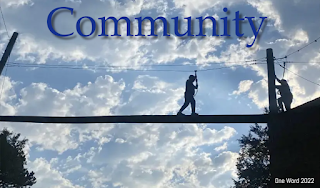
The picture I selected for my One Word background is from the Missouri Leadership Academy's Outdoor Leadership Experience (OLE) this past fall. Here I am facing my fear of heights by completing the climb and crossing over to the climbing wall landing area. My OLE #TeamRabbits encouraged, supported, and cheered me on in helping me accomplish this challenge. This community was instrumental in my personal success. You see, my success was their success. We were a community working together to achieve unified goals throughout the OLE retreat. This powerful experience led me to rally around "Community" as my One Word for 2022.

What is your One Word for 2022? I look forward to learning about your One Word! Best wishes for an incredible 2022.

Photo credit: Erica Edwards (@EducateNEdwards) OLE participant and #TeamRabbit member. 

Sunday, June 12, 2016

Empowering Today's Learners through Student Voice

NOTE: This Blog Post was originally written for LeadupNow. It appeared as this week's featured Blog Post. To learn more about this forward thinking educational consortium go to: www.leadupnow.com

Within our educational system today, and at the heart of all that we do, rests the proverbial “student desk”. In that seat rests the most powerful, engaging, and often untapped school resource. By taking and making time to include student perspective and voice within the academic, social, and behavioral facets of the school day, you will witness increased student engagement, increased student buy-in, and decreased behavior concerns and issues.

Building relationships with your student it a non-negotiable foundation to create authentic student voice opportunities. Based out of Washington, D.C. Character.Org (www.character.org ) is a national organization that promotes, supports and fosters the Character Education Initiative. Their 11 Principles, resources, and local/state agencies can provide additional support in moving forward in fostering teacher-student relationships via the character education initiative. By establishing a positive school climate and fostering positive relationships with our students, we will see an increase in how our students react, respond, and refer to school activities.

So how do you begin? Why should you empower student voice? Well, we know that our students arrive to school each day with two questions. 1. Will I be accepted? 2. Can I do the work? In addressing these two important questions, we can help our students feel both welcome and accepted at school. We can also help them become better connected with their academic work.

How can you empower students by increasing student voice? Here are a few ways that we have been able to begin this process:

·         Principal Sound-Off: Each quarter provide students with the opportunity to share their thoughts, concerns and ideas with your Administrative leadership team. Counselors and administrators meet with the student these topics. Many times our students will be able to help problem-solve different areas of concern within the school community. They are also able to generate “new ideas” and initiatives to incorporate into daily activities. Provide feedback to students explaining which suggestions can be implemented. Also provide information to explain why specific practices and procedures need to remain in place. By giving the students this important feedback, you are honoring their voice (even when you cannot implement some of their suggestions and ideas).
·         Student-Led Organizations: Allow students to take the lead in facilitating, planning, and leading out your student organizations (e.g. Honor Society, Student Council, W.E.B./Leader Link). This provides them with authentic leadership responsibilities and opportunities. Our three key student leader organizations each have a specific focus (National Junior Honor Society: service to others, Character Council: promoting student voice and character education, and W.E.B.: student mentoring).
·         Student-Led Committees: Serving as facilitators, school administrators, teachers, and counselors can work alongside students with these committees. For example, two years ago we transformed how we approached our annual Veterans Day Celebration. Allowing students to share their voice and vision for this annual event, we were able to give this celebration a very personal and authentic voice. Moving the celebration to a school day assembly, adding a breakfast and including student speakers, our school community witnessed a revitalized celebration. Three years ago two student leaders approached our Administrative team with this vision in mind.
·         Classroom Leadership: Using the Leader in Me( www.theleaderinme.org ) initiative or other research-based practices will provide students with real opportunities to lead out class activities, responsibilities, and lessons. Making time to offer different types and kinds of leadership roles in the classroom helps to provide students with authentic responsibilities (outside of academic work). At the same time you will be building confidence and self-esteem for your students.
·         BYOD School: In becoming a Bring Your Own Device school demonstrates your desire to further engage students on a level that they are accustomed to performing. Please note that technology for technology sake is not the reason to introduce BYOD to your school. Instead BYOD can be used to enhance and further embed learning practices with your students.
·         Content Curriculum: Student voice and choice is another key to increasing student “connectedness” in the classroom setting. Start by offering occasions where they have a choice within assignments. At times you can offer different Project-Based or Problem-Based Lear

With all ideas, initiatives, and programs, it is important to begin slowly. Assess your current reality and then begin with a Backwards Design (based on your school’s Vision and Mission). From here empower teacher and student voice in designing, planning, and then implementing your student voice initiative.

Additional resources:
National Junior Honor Society: https://www.njhs.us
W.E.B. (Where Everyone Belongs) Leaders: http://www.boomerangproject.com
Student Council: https://www.nasc.us


Tuesday, May 10, 2016

We still have time to make this the #BestYearEver

During this time of the school year there are times and tendencies to let our guard down and not focus with the intensity and intentional fervor that we once employed.  Now more than ever we need to remain focused on assuring that our teachers have the resources and support and that our students remain focused on academic endeavors. As the school year begins to draw to a close for schools across the nation, we still have time to make this the #BestYearEver.
In thinking of how to maintain the momentum that each of our schools has developed and maintained throughout the school year, here are a few ways to keep that sustained focus:

In the classroom
·         Bell to Bell Instruction: Remind staff of the importance of taking advantage of every teachable moment.
·         Best Practices: Continue to implement those proven research-based best practices in the classroom.
·         Voice and Choice: This still remains a very positive and engaging practice. Allow students to have voice in the classroom. Watch them soar with voice and choice.
·         Parent Volunteers: Parents can provide support, assistance, and expert advice (based on their background, class content, and nature of the unit of study).
·         Share What works: Teachers can share their exciting end of the year units of study with each other. BreakoutEDU is an educational experience that can be embedded into the classroom all throughout the year. Why not start now?

As Administrators
·         Visibility: Remain visible before school, during passing periods, lunch time, and after school. Both students and staff want and need to see us as “present educators”. Besides, you can have incredible, short casual conversations both several students and teachers during this time.
·         Get into classroom: You may have completed your classroom evaluations, but we still need to be in the classrooms learning alongside our students and celebrating the work of our teachers. This is a great time to take what you’ve learned in the classroom and share with parents and the community.
·         Celebrate: Let your students, teachers, and parents know about the great things taking place in the classroom via your electronic mail notifications and Social Media.
·         Communicate with parents: Keep the channels of communication open during this time of the year. Parents enjoy learning about events, activities and hearing from us.
·         Teach alongside your staff: When getting in the classrooms, your staff may welcome you serving as a classroom leader and take the lead in facilitate learning for a class period or two.

We are so fortunate to be today’s educators. Yes we have increased responsibility, pressure, and accountability, but we also have at our fingertips incredible resources, social media venues, and students willing to take those academic risks to take their learning to the next level.

I am looking forward to hearing how your school year ended, so please share your success stories as the year begins to draw to a close.


Join with me in seizing each day to make this the #BestYearEver.

Sunday, March 6, 2016

Share, Showcase, Celebrate: "This is ME" Project

Academics, belonging, and social awareness are all components of our daily work with students. As educators it’s our hope and desire that once students leave our school (elementary, middle, or high), they will be firmly grounded with our core values. IF students leave our schools with a positive self-esteem, great relationships with peers and staff, and a solid understanding of academics, then we’ve prepared them for whatever the future holds for them.

In mid-January two of our alumni (Marissa and Ally) contacted me. They wanted to “pitch” an idea for the middle school. We checked our calendars and a meeting was set. Marissa and Ally explained that they wanted to allow the middle school students to express themselves, to assert their self-esteem by sharing how they feel about themselves. To let others know the real “ME”. They explained that the “This is ME project would allow the middle school students to bring this idea to fruition. This project also worked in conjunction with their Girl Scouts Action Project. More importantly, they wanted to celebrate middle school self-esteem!

So they created a Prezi to let our teachers know about the project and how it would be implemented here at Francis Howell Middle School. Our teachers presented this information to their students during a Character Connection Class. Each student was given three 3x5 cards. On those cards they wrote one word descriptions of themselves. These cards eventually made it to the “This is ME” display in our gymnasium lobby.

What a great idea….allow the students to share, showcase, and celebrate who they are. We talk about this, we consider doing this, and then two former students approach you about this idea and then it becomes a reality. It was exciting being able to sit back and watch this project unfold.  These two alumni worked with our Character Education Committee and did all the work to bring the project to our school. Thinking not of themselves, but instead of the self-esteem of each of our 840 students at Francis Howell Middle School, Marissa and Ally took their vision from “just an idea” to “reality”.


So the next time current or former students approach you with an idea for your school, make sure you clear your calendar and set aside time to hear how they can help make a positive and life-long impact on your school community!

Saturday, February 13, 2016

Today's Parent Communication

There are a multitude of communication channels that we can access each and every day. For our parents, we need to make sure to keep them in the loop.  Day to day activities and events are an integral part of the learning experience for our students and staff. From traditional forms of communication to contemporary Social Media venues, parents appreciate being “kept in the loop”.  Today it is important to let parents know what it happening at school. Selecting the appropriate communication is very important. Depending on what you need to share with parents, will determine which tool to use. Here are several different tools that I use to increase communication with parents.

One Way Communication Tools
·         Electronic News: This daily communication tool is a positive way to send out daily announcements updates.
·         Remind: This one-way texting took has become very popular with parents. They like receiving quick information via a text from teachers, counselors, and the administrators.  It’s a great way to set up different groups (or classes).  For our parents I have a class that allows me to send information for this stakeholder group.  This tool has increased parent awareness of different activities and functions taking place at school. Updated Remind features allow you to send pictures and add links to the Remind text messages.
·         School Management Systems: SISK12 or Infinite Campus are two communication tools that helps keep parent up to date regarding academics. Other venues like Edmodo, Class Dojpo, Schoology, and Google classroom allow parents to received more information regarding academics  and the individual classes.
·         Web-based Newsletters: This is a tool that I find to be extremely helpful. We started using www.smore.com for our monthly newsletters. It is a user friendly website that allows you to create family friendly newsletters.  You can send the smore newsletter to your parents via electronic news, Remind, or an email blast.
·         Website: Parents rely on our website. It is very important to make sure that the information is correct and current.

Two-Way Communication Tools
·         Instagram: This Social Media tool empowers the parents to get a glimpse into the school day.  Posting pictures that capture day to day activities lets parents see what’s going on without being at school.
·         Blog Posts: This provides periodic information for parents that relate to education and the learning process. Parents enjoy reading posts from teachers and administrators. It can serve as a professional development avenue for parents.
·         Email: This is an essential tool today to provide quick access information for your parents.
·         Email Blasts: A quick and easy way to send information to parents is to use the “group email” feature of your School Management System.
·         Facebook: A very popular Social Media tool, facebook empowers the school to connect and share a variety of things with your community. Upcoming events, celebrations, updates, or special notices.
·         Phone calls: Nothing can replace the old-fashioned, traditional telephone call to parents. They often appreciate calls just to let them know about something positive about their child’s day.
·         Twitter: Another Social Media tool that gives parents another venue to participate in two-way communication.  Parents can reply to tweets, ask questions, and access school resources that have been tweeted out from the school, a teacher, or administrator.
·         Twitter Chats: These chats provide parents with a chance to use their Social Media skills in a collaborative way to share ideas and thoughts. Chats can be a way to continue integrating Social Media into the school setting.


Although it is very easy to slide into the habit of using Social Media, parents also like the tradition forms of communication. By finding a balance between the two formats, you are able to reach all of your parents. I find that by using both one-way and two-way communication tools, parents appreciate knowing that there are times when they simply need information and there are times when they appreciate the opportunity to reply or communicate back to the school.

Sunday, January 3, 2016

Connect… My #OneWord for 2016

Interestingly enough I have been absent from the world of blogging since this past June (2015) and so today I am writing to introduce my #OneWord for 2016 which is CONNECT. Today I am re-connecting with the blogging world. I have taken some time in focusing on other facets of my career and family. So as 2016 begins I am once again establishing communication via my blog.

In lieu of establishing a New Year’s Resolution (or resolutions) I am continuing with the practice of selecting One Word that will define my focus for the year.  Like I mentioned, CONNECT is my word for 2016. As a school administrator it is so very important to connect (personally and professionally) with my staff, students, parents, and greater community.

In our fast paced society, we often fail to see the many things that truly require our attention. At work we can get caught up on the “job” and fail to see the many important things that are around us and need our attention. By continuing my focus to CONNECT it is my desire to make sure I do not lose that focus by staying CONNECTed with each stakeholder community.
 
So I challenge you to move away from the resolutions and select that One Word that will define your focus, purpose, and destination for 2016. For more information, check out Jon Gordon’s website www.oneword.com


I look forward to hearing about your One Word for 2016 and how is shapes your work, life, and leisure time this year. Best wishes. Make it the #BestYearEver !

Friday, June 26, 2015

The Significance of the Family Reunion

Our families come to us in different shapes, sizes, color, and quantity, and temperament. We have our immediate, extended, adopted, school, and professional families. Each member and group helps us to “share”, “celebrate”, “give thanks”, and “grow” This week I was fortunate enough to be part of a unique and very special family reunion. I attended the 50th Family and Community Engagement Conference (sponsored by the Institute for Educational Leadership) to present, learn, and to meet my #PTCamp PLN family.

In June of 2014 I joined a Voxer Book Study with Joe Mazza (@Joe_Mazza) and 100 professional colleagues. We read, discussed and dissected Mapp and Henderson’s Beyond the Bake Sale.  During the past 12 months I have remained “connected” with 21 of my book study PLN Pals. This journey started out as a typical 6 week book study. However, very unexpectedly it transformed into a family of educators that spanned 10 time zones and multiple countries.

During this conference I met in person, or the first time, twelve of those colleagues.  Although it was our first time meeting each other in person, we had grown professionally and personally during the past 12months via Voxer, Twitter, and other Social Media tools and venues.

My reflective thoughts…
Share the good the bad and the ugly with your family. It is important to be transparent and to be open and honest with your family. This is how we build relationships and continue on our learning journey.
Celebrate the great things that are happening NOW. Create memories from what happens today. It will help tell your “story” and to prepare you for your future.
Give Thanks for the family that surrounds you each day. These special individuals are here to help, support, cheer, and encourage you. Take time to give thanks to those special individuals in your life.
Grow by learning from your family. You may not always share the same opinions, beliefs, and philosophies, but you can always learn from those family members who deeply care about you.
So you my #PTCamp PLN family, thank you for this incredible Family Reunion.

My #PTCamp PLN:

                          Sharicca Boldon                                  Lea Ann Johnson
                          Chad Caddell                                       Joe Mazza
                          Peggy Cormeny                                   Ivonne Padilla
                          Vicki Day                                              Julie Pile
                          Geniene Delahunty                            Debbie Olsen
                          Jim Detwiler                                        Jay Posick                             
                          Ben Gilpin                                            Becky Raabe
                          Shari Hardinger                                  Jeff See
                          Anthony Hockey                                 Mary Ann Stewart
                          Sheilah Jefferson-Isaac                     Brenda Vatthauer
                                                                    Joy Wright

I learned so much about Family and Community engagement-involvement-leadership during this conference. It stretched and expanded my “knowledge band”. It enhanced my awareness of how we can take our family and community to greater levels of connectedness within our schools and districts.


So when you get the opportunity to attend a Family Reunion, do not pass on this incredible opportunity. No matter the obstacle or obstacles that are in your way, do what you need to do in order to be part of the Family Reunion experience – It will transform your life. 

Tuesday, May 26, 2015

Change is hard at first...

Change for change sake is meaningless, wasteful, frustrating, and non-productive. Now change that impacts students, staff, and your school community in a positive manner is exhilarating, celebratory, refreshing, and renewing, and healthy.

So as the school year draws to a close it it’s important to reflect on what worked, what did not work, and what could be tweaked to be even better.

Change… Sometimes we need a new perspective to reflect on our own practices. Then we can determine what facets of our practices need refining. Here are three key areas that are important to consider:

Relationships – Do your students believe that they are important, significant, and able to do the work? Do your students know that you care? They their work is viable and relevant? By first building relationships with your students, you set the foundation for a positive and richly rewarding academic journey. Your students will readily take on more challenging tasks because they know you believe in them and in return, they will believe in themselves.

Rigor- Do you believe that all students can achieve at high levels? If so, what is the barometer reading on the rigor? Are we doing what is best for students? This work receives quite a bit of grief. However, if we do not take time to really consider what is rigorous and what is not rigorous, we may miss the boat completely on helping our students move beyond where they “are” to get to where they “should be”.

Relevance – The work our students are completing in class. How relevant is it to their learning? Have we moved beyond worksheets and coloring? At different junctures in lesson work a worksheet or color element can supplement learning. However these two elements should never take center-stage in the learning process. In looking at the big picture and planning for next year. It is important to determine the true relevance of each facet of the learning process model.

Change does not come easy at first. As a culture and society we are creatures of habit and change does not always sit well with us. So I challenge you to earnestly look at the three Rs (noted above) and determine “Where you are right now”, “Where you want to be (when school starts)”, and “How you plan to get there”.


I plan on taking time this summer to reflect on my school year and to determine what facets, areas, and strategies that need “change” in my own practices.

Resources:
Character.org (formerly Character Education Partnership) is the leading national organization that supports character education in our schools and communities. Their philosophy is based on the 11 Principles of Character Education.  http://character.org/

The International Center for Leadership in Education (ICLE) is a great resource. The breadth and depth of information relating to Rigor and Relevance will help you in your journey. http://www.leadered.com/

McREL International, which supports their Nine Instructional Strategies research and best practices, is an excellent source for you. McREL work in educational research and practical application will greatly benefit any school or classroom.  http://www.mcrel.org/

Wednesday, April 22, 2015

The “New” “Old” Lesson Objective

During the traditional Pre-Observation Conference, the question about “What is the lesson objective?” often surfaced. So what is so important about the objective? In looking at backwards design, if we understand what we want the students to learn, take away from, or further develop during a specific classroom lesson, then we can fully develop a lesson that will help the students master the lesson objective. The lesson is much more that your thoughts for the day or a list of activities to accomplish during the class period.  The lesson objective should drive your instruction. It should direct, challenge, and empower your learners.

The McREL instructional strategies are research-based best practices for classroom instruction. This year our school began the year with an intentional focus. We determined that we would focus on the McREL strategy of the “objective”. We knew that by focusing on this key element of the lesson that we could make intentional gains in student understanding of the Learning Standards. We utilized PD time, faculty meetings, plan time meetings, and time during our August Teacher Meetings focusing on this new approach to using objectives in the classroom. Thanks to McREL and Classroom Instruction That Works by Dean, Hubbell, Pitler, and Stone, we have progressed through our journey in transforming our educational practices.

In implementing the lesson objective with Quality, Fidelity, Intensity, and Consistency (QFIC), there are four McREL recommendations. These four components must be included during the instructional facets or phases of the given lesson:

1.      Set learning objectives that are specific, but not restrictive,
2.      Communicate the learning objectives to the students and parents,
3.      Connect the learning objectives to previous and future learning,
4.      Engage students in setting personal learning objectives

In working with our teachers, leadership team, and Classroom Instruction That Works trainer, we were able to see, over the course of this school year, a transformation in how our school prepares, writes, and implements the use of the “new” objective.  Students are now having discussions with partners where they are personalizing the lesson objective and making it relevant to their work during class. From the Physical Education unit on volleyball to the choir lesson where the students analyzed their choir concert performance, or from the English Language Arts lesson on Argumentative Writing, to the Science lesson where students will understand the difference between position, velocity, and acceleration, our students are personalizing their learning and are making deeper connections within each content area of study.

In monitoring our progress, we have well over 55% of our walkthrough observations noting QFIC implementation of the lesson objectives.  The “new” “old” objective has transformed how we think about, consider, write, and implement the lesson objectives in our classroom each and every day. 

So as you evaluate your work with student learning this year, I want to challenge you to revisit the “old” lesson objective and consider looking at the “new” lesson objective!

Sunday, March 29, 2015

Why are there Erasers on our Pencils?

Learning and sharing with my professional colleagues is always richly rewarding. This past Saturday #Satchatwc, regularly hosted by @Burgess_Shelley (Shelley Burgess), was moderated by @dayankee (Don Eckert).  The chat focused on School Culture from the Student Perspective. In reflecting on student learning, I posted this quote (see above) during Saturday’s chat.

Today there are times when we obsess over the desire to be correct or right; thereby skipping right over the opportunity to be “wrong” or “fail”. It is this critical misstep where learners (both students and adults) will lose out on opportunities to learn at a greater depth. When growing up I gained experience from my mistakes when learning how to ride my bike, drive a car, and complete projects for school, and learning the ropes in college (undergrad and post graduate work).  Unfortunately, during those times of “failure” I did not see the future benefit from my mistakes. Only today as an adult do I see how I learned from those “teachable moments” growing up.

Things to consider…
·         Promote a Growth Mindset
·         Encourage students to take risks
·         Offer Student Voice and  Choice
·         Use Real World scenarios in student learning
·         Celebrate learning and –relearning

Students also learn when they see us as educators sitting in the proverbial “student desk”. Our students then see us as active learners. Every day each of us continues to learn and grow. Part of learning is making mistakes, experiencing failure (to some degree), and then learning from those rich educational experiences.  Here me out, I am not encouraging you to “promote failure and mistakes”, I am merely noting that we should allow students to learn and grow from mistakes and errors.


I look forward to hearing your thoughts on the idea of growing from re-dos. Erasing and correcting, and learning from failure. So since we have erasers on our pencils, we should use them!

Sunday, February 15, 2015

Iron Sharpens Iron

As individual educators we know our personal professional development needs. Today we are blessed to have access and exposure to a multitude of professional growth opportunities. Social Media has opened doors for us to learn, share, and grow as educators. We now have immediate access to Best Practices that we can comprehend, dissect, discern, then apply. We have our Professional Learning Networks to “bounce” ideas off of, to study alongside, and to cultivate professional friendships.

As a reflective practitioner, I look back on the traditional ways of learning and I see that it was beneficial. I am also reflecting on the way I am acquiring new knowledge today, and I have to admit that I prefer the personalized and immediate format and style of today’s PD.

Just a few ways to sharpen the iron…
EdCamp: The official “Un-Conference, the EdCamp experience will bring hundreds of educators together for a single day event. Where else can you get breakfast, lunch and over a hundred breakout PD sessions in a single day? All for free!

Twitter Chats:  If you have yet to take advantage of the Twitter Chat PD, now is the time to jump in. Chats are informal ways where we can learn and share with like-minded educators. In addition, is it also vital to our learning to dialogue with those who may not hold the same opinion, belief or educational practice.  Here is an extensive chat list compliments of: @Cybraryman1

Professional Learning Network (PLN):  This network will help expand the breadth and depth of your personalized learning. Join or create a PLN today.

Traditional Conferences: Although some may refute the need for local, state, and national conferences, they (in their own design) can bring a large number of educators together who possess a single focus.   I just returned from attending the Midwest Education Technology Conference (METC). I will be able to take back so much information to my school and district.

Shout Outs are in order for:
·         My Moderating Teams- #MOedchat (ModSquad) and #PTchatModerating team.
·         My Voxer PLNs- MO ModSquad, PTcamp, Leading in the Middle, and PTChat Moderators),   
·         Chats: #MOedchat and #PTchat
·         Midwest Education Technology Conference (METC)  


As “Iron sharpens Iron one man sharpens another” so we must continue to move forward on our journey and continue with the vital responsibility to “sharpen each other”. Make it a great day or not, the choice is up to you!

Sunday, January 11, 2015

A New twist involving Student Voice

We often discuss the importance and significance of “student voice” in our schools today. This term can truly embrace several different components.  We know that students thrive when their voice is heard and their ideas incorporated within building practices, classroom protocols, and class lesson activities. What follows is the work to include student voice in building practices.

Last spring we began talking about ways to restructure, revamp, and revise the way we select our school’s Teacher of the Year and our Support Staff of the Year. Our Climate Committee met. And one idea that quickly surfaced included student voice in the new selection process. The Committee finalized the revised format and unveiled the new protocols this past August (’14). 

Our middle school decided to include students in the nomination process. So student, certified staff, and support staff can all nominate teachers for this honor. Within the student voice facet, the committee determined that 8th graders would be included in the nomination process. As the 8th grade students would be the group of students who would have had exposure to all grade levels, they would have the best student perspective for this process. Nominations concluded in December.  Finalists were selected from the nominations (top five in each category) and voting just concluded. Again 8th graders and our staff voted. We will announce our 2015 Teacher of the Year and our 2015 Support Staff of the Year on Wednesday January 21, 2015.

The most exciting thing is how our school has honored student voice in an area where recognize outstanding work and contributions made by our certified and support staff personnel. So why not include student voice in this selection process? During the past few  years, following the announcement of our staff members of the year, students have been asking the question, “Why don’t students have a vote in our Teacher of the Year?” That question has been answered and now our students have a voice in this selection process.  Student voice consists of 1/3 of the final vote and staff voice consists of 2/3 of that voting process.


I am looking forward to the committee making these two announcements later this month. It will be the culmination of work from our Climate Committee and the voiced requests from our students.  What an exciting way to kick off second semester and 2015! 

Thursday, January 1, 2015

Say goodbye to the “New Year’s Resolution”…

Each December, usually on the 31st, I would create my list of resolutions for the new year. Needless to say, by the end of January, I have broken most of them or I’ve tossed them by the wayside.  One year ago today I was watching the Today Show with Al Roker and Natalie Morales. They interviewed Jon Gordon ( @JonGordon11) author of One Word that will change your Life. Jon shared his “One Word” initiative or project. Jon tells us to select one word that will guide and direct us throughout the new year.  For many that “one word” jumps out at you, for others it takes some soul searching. Jon explained the three step process: 1. Look In, 2. Look Up, and 3. Look Out.

Look In: What do I need? What do I want? What do I need to focus on?
Look Up: Look to God. There is a word that is meant for you. When you are “open” you will find this word.
Look out: Live your word. Make this word a part of your life.

So after watching the interview I selected my word for 2014 (Character). As a National School of Character I wanted to keep “character” at the forefront or top of my daily agenda. I wanted to make it intentional and purposeful. I wanted a simple daily reminder. Then I met with my administrative team and they each selected their word. We introduced the One Word initiative to our staff. This has helped each of us stay focused throughout the year. We even had teachers lead out the initiative in their Character Connection Classes.

So, now it is January 1, 2015, and my One Word is Dilgence (careful and persistent work or effort. Synonyms include: conscientiousness, persistence, rigor). This single word will help me achieve both my personal and professional goals. It worked for me in 2014 so I know it will do the same in 2015!

Here is the link to Jon’s One Word Website: http://getoneword.com/
This link takes you directly to the Poster creating site: http://getoneword.com/share/
Watch Jon’s Today Show interview: http://www.today.com/video/today/53957503#53957503

So my challenge to you today is to revisit how you use the New Year’s Resolution and rethink how “One Word” could transform your focus for 2015. Say Goodbye to the New Year's Resolution and say Hello to One Word.  Allow this very simple concept help transform and redefine how you can use a single word to provide direction and focus in all that you do! 

I look forward to hearing how “One Word” impacted your year.


Monday, December 15, 2014

The Magic of Technology Integration…

As a Bring Your Own Device (BYOD) school we are in our second year of working to further implement technology in the classroom from the student perspective. Meeting the students where they are allows us to empower them to use their devices when academically appropriate.  Today I visited several classrooms and among those classes I was able to visit two of our elective or non-core areas: vocal music and physical education. What I was able to witness was “the magic of technology integration”.

As I walked past the first choir room door I noticed the students sitting on the choir risers and as I entered the classroom our choir teacher was talking to the students. As I took my seat at a side table, our choir teacher didn’t miss a beat and led the students to the next facet of the choir lesson. Today they were analyzing their performances from last Monday’s Winter Choir Concert. With her AppleTV ready to go, and the Padlet website ready to roll, the students were ready to talk about their personal reflections. Multiple students accessed with Padlet website from their personal devices. It was so cool to see the students simply access their devices and open up the website                             (www.padlet.com ). Using the Padlet projection on the screen or their own devices the students were able to engage in shoulder partner discussions, small group, or whole class conversations! This educator has taken the next step in integrating technology in a student-friendly way that empowers student: learning, voice, and ownership.

Later in the morning I stopped by an  8th Grade PE class. This time two PE teachers we in the middle of the Communicable / Non-Communicable Disease Project with their Health classes.  With the opportunity to use PowerPoint, Prezi, emaze, PowToon or any other presentation media, the students were given the freedom to create their educational journey presentation for the class.   During the health class each student presented their research. The students led out the presentations, the student audience led out the question and answer sessions and the two classroom teachers facilitated the learning experience. It was  exciting to see the students as lead learners in front of their peers. It was just as rejuvenating to see their peers engaging in the Q&A session with higher level critical learning questions.


The magic of technology integration opens the doors for all learners in all content areas. So when you are in doubt that technology integration is possible, simple reflect on these two examples where teachers pushed and challenged their students to take their learning to the next level. Simply believe in your students and your ability to use technology to enhance, supplement, and compliment the classroom learning environment. It is our responsibility to challenge our students to catapult their learning to the next level. I am looking forward to hearing of the messages and learning stories from your schools - as to how your school it using the "magic of technology integration" in the classroom setting!

Sunday, November 30, 2014

Difference Maker...Change Agent...

Each of us has the opportunity to be a “difference maker” or a “change agent”.  This opportunity presents itself each and every day of the week. As parents, classroom teachers, administrators, and community members it is our responsibility to “seize the moment” and take full advantage of each and every teachable moment.

How can we do this?

Accentuate the positive: Look at the positive opportunities from each learning lesson. Remember that we all can learn from each “growth moment” in our day.  Failure is “ok”. We can learn from mistakes and turn those experiences into a new learning experience.

Access resources: Use proven, researched-based strategies to help move the learning process forward. We are surrounded by a multitude of strategies. Just select the one that works best for you (and your learners).

Networked Partnerships:  Rely on trusted colleagues for advice and support. Your Professional Learning Network (PLN) or your Professional Learning Community (PLC) are two reliable and dependable avenues to garner support and information.

Take Risks: It’s ok to try something new. As long as it is going to make a positive impact and meet the learners” where they are”, then it’s full steam ahead.

Whether you are working with Common Core State Standards, a new online teacher evaluation tool, a revised budget, your parent organization, you can take charge and lead your group, classroom, or school forward.  You simply need to be “that” educator who is ready to be the change agent for your school community.


Wednesday, October 29, 2014

Getting back to into the classroom…

As an educator I firmly believe in creating a learning environment and atmosphere that will empower both the classroom leader and the students.  Professional development opportunities provide time for our teachers to learn, study, and practice with proven strategies, methodologies, and technology. It is very important that we do not embrace change for change sake, but instead use advances in pedagogy and technology as ways to improve the delivery and application of our instructional work.

Two weeks ago I was approached by one of my teachers with a proposal that I could pass up. This teacher is part of the iPad initiative where our school district is working to introduce class sets of iPads for classroom use. She was beginning a unit on Standard of Living and spatial inequalities in her 6th grade Geography class and wanted to create an assessment that would challenge her students, assess their knowledge, allow for student voice, and provide an opportunity for the students to integrate technology into the classroom.

As a social media and technology enthusiast, I was excited to learn of the proposal. I was going to be able to get back into the classroom and teach for a day. The students were going to learn how to use Prezi to create a multi-media presentation for the “Life is not fair…or is it?” project.
So I developed my lesson and focused on how I could teach the skills that each student would need to so that they could meet the lesson and unit objectives.

Here are a few things that I learned from my day in the classroom:

Model for your staff and students: Often we speak of “best practices”, technology, Social Media and Apps that can be used in the classroom. If you take on the role as classroom teacher (for an hour or a day), you can take the opportunity to put into practice the methodologies, technology, or social media facets that you promote and encourage the teachers to use and implement. For me I was able to teach the students how to use Prezi. The majority of the students were not familiar with this presentation tool.

Get back into the classroom: Each year administrators become “one more year” removed from the classroom. By seeking out or accepting teacher invitations, we must make time to return to the classroom where we can teach the students. It is important that our teachers see us doing this and it is just as important for the students seeing us as engaged leaders in the classroom.

Iron sharpens iron: We learn best when in fellowship with our colleagues. By working alongside the classroom teachers we both can grow and learn. As I was teaching, the classroom teacher remained in the classroom. We became co-teachers. We both offered ideas and suggestions each class period. She learned about the Prezi and how to integrate it into the assessment process. I learned how to work alongside the different student learning styles, personalities, and needs from the academic and student-centered perspective. I followed up by returning the next day to visit with one of the classes. I offered additional information and insights from yesterday’s lesson. The students shared with me the “things” they learned about using Prezi during the last 24 hours since we were in class together. Collaboration and learning from one another is always a great “best practice”.

So, my challenge to you is to find that opportunity where you can return to the classroom to teach alongside or to teach independently. Either way it is a rich, rewarding opportunity for not only yourself, but for your teacher and your students. I am fortunate that I work alongside such incredible professionals and motivated students.


I was able to take a day and return to the classroom and spend time with 150 of my 6th grade students and a teacher who had the vision to invite me “back into the classroom”!